
Have you ever noticed how your eating habits mirror your relationship with possessions?
What if the same factors driving weight gain are also fuelling your clutter accumulation?
Could understanding these hidden connections finally unlock lasting change in both areas of your life?
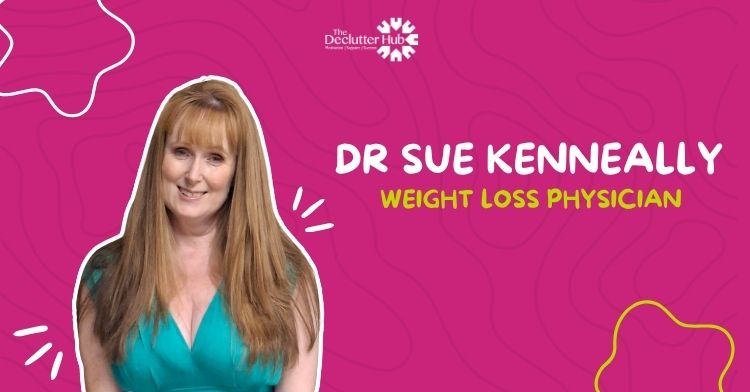
Ingrid and Lesley explore these fascinating parallels with UK weight loss physician Dr. Sue Kenneally, who reveals how modern environments push us towards overconsumption in every aspect of life. This episode uncovers the surprising similarities between weight management and decluttering, offering fresh perspectives on creating sustainable change.
Dr. Sue brings her medical expertise to bear on why both clutter and weight gain have become such prevalent issues in today's world. From dopamine-driven shopping habits to stress-induced comfort seeking, she explains how the same underlying patterns affect both our homes and our bodies. The conversation delves into practical solutions for transforming your environment to support healthier choices, whether you're tackling your wardrobe or your kitchen cupboards.
🎙️ In this episode:
- Clutter Meets Weight
- Meet Dr Sue
- Why Things Changed
- Overconsumption Patterns
- Dopamine Comfort Loop
- When It Becomes Problem
- Trauma And Coping
- Why Patients Seek Help
- Motivation And Referrals
- Kitchen Setup For Success
- Clearing Treat Foods
- Food Waste vs Self Care
- Declutter Your Kitchen Tools
- Remove Exercise Barriers
- Habits and Pattern Shifts
- Non Scale Victories
- Why Diets Plateau
- Life Happens Stay Consistent
- Transformations Feed Each Other
- Self Compassion and Support
- Freedom Clinic and Wrap Up
🕺More about Dr. Sue Kenneally
Dr. Sue Kenneally is a UK-based weight loss physician who helps people achieve sustainable weight management through evidence-based approaches. She founded the Freedom Clinic, where she combines medical expertise with practical lifestyle strategies to support patients in creating lasting health transformations. Her work focuses on understanding the root causes of weight gain and developing personalised solutions that work with, rather than against, people's natural tendencies and life circumstances.
Connect with Dr. Sue Kenneally:
It's Not Your Fault - FREE Weight & Wellbeing E-Book
This episode challenges conventional thinking about both decluttering and weight management, revealing how addressing one area can create positive ripple effects in the other. You'll discover why extreme approaches rarely work long-term and learn practical strategies for setting up your environment to support your goals naturally.
The discussion covers everything from organising your kitchen tools to make healthy cooking easier, to understanding why both clutter and weight issues often stem from the same emotional triggers. Dr. Sue's medical perspective adds valuable insights into the physiological aspects of habit formation and change.
What resonates most with you - the connection between shopping habits and eating patterns, or the idea that environmental changes can drive behaviour shifts?
Share your thoughts in the comments section below, and don't forget to subscribe for more episodes exploring the psychology of decluttering! 🎙️
Prefer to read rather than listen?
Transcript of this podcast episode
Lesley: In today's episode, we're exploring the connection between clutter and weight, how both can be driven by emotional patterns over consumption, and the pressures of modern life. What we can do to create the right environment for lasting change. I'm joined by Dr. Sue Kenneally, a specialist weight loss physician who works across both the NHS and the private sector here in the uk, supporting people to make sustainable, realistic changes to their health and lifestyle. Sue is the owner and director of the Freedom Weight Loss Clinic, a published author and international speaker, and a leading expert in weight loss.
Ingrid: Hello and welcome listeners. I'm Ingrid.
Lesley: And I am Lesley. Now, if you are here for the very first time today, or you've been listening in for ages, we want to say a huge thank you we have a little favour to ask.
Ingrid: If you like what you hear, be sure to hit that follow or subscribe button. Share us with your friends or leave us a review. It makes a huge difference to us.
Lesley: Welcome, Sue. I am so excited to have this conversation. Thank you so much for reaching out to us. You reached out to us and you're like, I love your podcast, and I wanna come on and talk about the, the comparison between weight and clutter.
And we're like, yes, let's do that.
Sue Kenneally: Yeah. Hi Lesley. Thank you so much for having me. I'm very excited to be here and as you say, I am a big fan of, of the podcast. This is great.
Lesley: Oh no, it's great. And do you know, I was just saying to Sue before we hit record. Back in the day when I first started out with the clutter fairy, I used to blog and, and then sort of connect into social media. This is going back 16, 17 years now, and one of the very first blogs that I wrote was about how weight, weight and clutter are so similar and so aligned, and it's a bit of a chicken in and egg, isn't it?
So we're really gonna dig. That today we're gonna talk about the why a little bit, and then we are gonna talk about obviously, practical steps that you can take at home to try and facilitate transformation, whether that's in your decluttering journey or in a weight loss journey, or both. So that's the way this is gonna go. so let's dive straight in. So things are different Sue now than they were back in the day.
I'm gonna talk about 16 years ago, but let's go back 50 years, 70 years. Clutter wasn't really a problem. Weight wasn't really a problem. Things have changed. What's changed and why?
Sue Kenneally: Well, I think it's our environment and, Our society that have changed. So way back, you know, when I was a small child, people didn't really have very much in the way of possessions and we mainly ate very basic foods. ready meals weren't a thing when I was certainly a very small child. whereas they are now, and they're not entirely to blame of course, but that's just an example.
but essentially. we just didn't have the money to spend on excess food or extra possessions. We bought what we needed and most of the time we really meant what we needed. We didn't have much extra for, More of what we want and, and the accesses and what's changed in the last 50 years is that we've created an environment where it's much easier to overconsume both possessions and food and drink.
And so the consequences of that are that we have, a lot of us have a lot more, more cluttered homes, or we certainly own a lot more, even if it's not in a cluttered state. We, we own a lot more than we used to, and a lot of us eat and drink a lot more than we used to, simply because it's more available and it's more affordable.
Lesley: And you know, the odds are stacked against us with these marketing machines as well, right? So we are bombarded everything on social media, on tv, on radio, on podcasts, even. You know, we're bombarded with things to buy. Whether that's food or whether that's other things. so it's hard out there, but nevertheless, we find ourselves, there's no point in lamenting where we were before.
We are where we are, we're firmly in the 21st century and people are really struggling under the weight of clutter and under the, under the weight of weight as well, aren't they? So. Let's talk about the patterns between the two. Now, obviously in our world then, overconsumption really comes in the, in the form of shopping, acquisition, whatever we want to call it, and that gives us that dopamine hit. the same can be said for weight. So how does it show up in the, in the, in the weight world?
Sue Kenneally: So in the weight world, there's all kinds of things that conspire. So, I often say in response to this kind of question, we, we now know from previous research done about 10, 15 years ago, that there are about a hundred causes of weight gain in the UK and almost all of them. Are beyond the conscious control of almost all of us, which is why almost all of us go on to gain weight.
so thinking about those, it's our environment, which can include our food environment. So it can mean ultra processed foods. It can mean the food industry, as you say, doing their very clever things to make us buy more. The, the buy one, get one free's, and, the extra deals and, making. The cheap food, the really tasty, palatable, addictive food because there's a whole industry dedicated to making food addictive.
So if something's got high salt, high sugar, and high fat in particular, those three together, that will be addictive food to the majority of people, and it'll just make you want to go back and buy more. And then you multiply that by making it. Extra available and extra cheap and suddenly you've got yourself a very saleable product.
So that's the physiology. And then just our high pressure environment. We, we add in extra busy lifestyles and people under pressure to do a lot more than they used to have to fit into the average 24 hours. Then convenience food becomes not only addictive, but it becomes the only thing you can manage 'cause you haven't got time to do anything else and it all just compounds over time.
Lesley: It was interesting actually, 'cause I was listening to another podcast and something that somebody said really hit home. They were, they were talking again about how things were much simpler, you know, back in the day. and particularly as children saying, really what you could expect going back 50 years was, was that you were fed and you were loved, and that's the extent of what you got as a child,
Sue Kenneally: Yeah. Yeah.
Lesley: from the truth.
Right?
Sue Kenneally: Yeah.
Lesley: like, that is. So true. But nowadays, you know, we, we work, we have so little time. Our time is squeezed as parents, isn't it?
Sue Kenneally: Mm-hmm.
Lesley: And we're like, you know, we've gotta get that food on the plate. Like you say, you've got budget budgetary requirements, we've got marketing, we've got not, not just our own marketing.
We've got that. Our children are seeing it on TV programs
Sue Kenneally: Yeah,
Lesley: that. You know, it's just everywhere, isn't it? And so it's really difficult.
Sue Kenneally: absolutely. And as you say, it's a billion dollar machine and we are more or less defenseless against it.
Lesley: Exactly that. so what do we think about things like comfort eating and let's talk about dopamine because we are, you know, we're talking about kind of the. know, they're eating the and inverted commas, food that's full of fat, full of sugar, full of salt, all those things that we love and we crave.
It gives us a temporary hit, doesn't it? And, and it's very similar of course, to that dopamine hit that we get when we go shopping.
Sue Kenneally: Yeah, absolutely. So, it really does comfort you in that moment because it is often designed to act exactly like a drug and it does act in your brain like a drug. So at the time that you're eating it, it really does feel like it's providing comfort. But of course there are the long-term consequences to it, and, and that's where the problem is.
If it wasn't encouraging people to gain weight over time, it really wouldn't be a problem. But it's because it comes with associated excess weight, possibly high blood pressure, diabetes, all the health problems that we know can come with living with extra weight. If it wasn't for those things, it wouldn't be a problem at all.
But sadly it does come with those things and that's what makes this so difficult.
Lesley: We sit here and we talk about it now, Sue, I go, okay, that makes sense. You know? Well, we should stop doing those. We should stop buying the stuff with salt and sugar and fat, and we should go for a more healthy lifestyle, and we should, you know, we should ignore all the marks. Machines, but it's not as easy as that is it?
And you know, because these habits have been formed over years and years and years, and I think that. What I find or what we find in our world is that in, in the clutter world is that possessions are a form of comfort and they can feel safe and make you feel as if somehow you are in control. Even though you are effectively out of control, you can feel in that moment that, that there's a safety net around you, don't you think?
Sue Kenneally: Absolutely. It's exactly the same thing, and as I say in the moment, it really, really works. And, to, to go on from that, if you're trying to feed your children. it's the easiest thing in the world to just feed them food that you know that they will like. 'cause it feels like a treat. You don't have to have the battle at the dinner table.
You just go, here you are family, here's some lovely food. They enjoy it. Do the dishes. It's done. It's a nice, painless experience for everybody. but it's not what's helping us all at the fundamental level in the long term. So that's why it's a problem.
Lesley: Well, it's so interesting that really you talk about that in terms of, and these habits form, young, aren't they, with children? And we're
Sue Kenneally: Yeah.
Lesley: habits and things like that to them It, you're saying effectively is that the, the easy way out is to give something that's probably ultra process that the kids are gonna love, that they're not gonna turn their noses up, all those kind of things.
Sue Kenneally: Mm-hmm.
Lesley: thing in the decluttering world is to leave it as it is because battling against your emotions in the decluttering world is hard. You know, to try and do something, to try and push yourself out of your comfort zone and do something
Sue Kenneally: Yeah.
Lesley: is difficult. And so we feel much safer and much, much more in control just carrying on as we have. we have done. But then it comes to a point, whether that's weight or whether that's clutter, where it's not comfortable anymore, where it's, it's detracting from what you want to do with your life, you know, in terms of weight, whether, whether where it's stopping you from playing with your children, whether that is or going out on a nice walk with your partner or seeing your friends or all of those things that, that, you know, an excessive weight, provide.
It stops you then it's no longer comforting, isn't it?
Sue Kenneally: Yeah, so I think it's really great to mention this at the beginning of this, podcast that there are a lot of people out there, and I, I have to say, I salute you who are living in a bigger body. And for them it causes no problems whatsoever. They don't feel any of the limitations at all. They don't have any health problems for them.
Their shape, their size is not anything they're concerned about. In fact, many people celebrate living in a bigger body. And just to set this out at the beginning. I don't think there's any problem with that. In fact, I think it's fantastic and I hope it continues long term for you. What we're talking about here is when it does become a problem.
Lesley: Yeah, definitely. And again, this is where, this is why this conversation is so f 'cause there's so many kind of comparisons really. It's exactly the same. People have got different levels of tolerance, of clutter. And so some people prefer a minimalist kind of home and some people are quite happy having loads and loads of knick back, knickknacks around. But really it's about. When it starts to become overwhelming for you, when you feel like it's out of control, when it's stopping you from doing things that you want to do when it's becoming a negative force in your life rather than a positive one. And so far be it promotes to ever dictate what somebody's body should look like or what somebody's home should look like.
But it's about you having that realization in yourself and saying, this is not what I want anymore and I really want to change. And I think that, you know, we, we have to. Also acknowledge in terms of the comparison that a lot of this comes from trauma, stress coping mechanisms. So this is things, sometimes an excessive weight or a, a, you know, a, a lifestyle that's not as healthy as you would want it to be. Comes from a really difficult place, as does clutter, right, Sue?
Sue Kenneally: Yeah, absolutely. So particularly in my NHS practice, where I've got a whole team around me of dieticians and psychologists. And so on. what we know from talking to our patients in that context, that the majority of them have some form of trauma in their past. And picking that apart and reframing it and dealing with it can take a huge amount of time and can be very, very painful.
So it's much easier to sort of stuff it down with some food than it is to actually bring it to the surface and deal with it. And we shouldn't underestimate how complex that can be.
Lesley: Seems like a really good time, Sue, for me to ask you, why do people come to your clinic?
What makes them make that jump to come to your clinic?
Sue Kenneally: yeah. Great question. So it can be any number of things in the NHS. it can be all the usual reasons that you might expect people who are, They're experiencing the kind of problems that we've talked about already. sometimes it can be things that have come, unexpectedly to them. So for example, we see a lot of ladies who have been told by their gynecologists that they need to lose weight in order to access fertility treatment.
and until this happened, they had no concerns at all about their weight. similarly, Usually people who are slightly older will be told by their orthopedic surgeon that, they need maybe a new hip replacement. and they've been told that the operation would be a lot safer if they were to lose a bit of weight and so on and so forth.
So those are the people who typically didn't have a problem with their weight at all until that happened. And then that brings them to my door. And then, in the bigger picture. there's all the things that you might expect. So people who are not happy with how they look, they're feeling under pressure to improve their appearance, or maybe they're worried about their health.
So they've been told that they might be at risk of getting diabetes or high blood pressure, or they're worried about their aches and pains or, Living well into older age and there's a big, body of research now around, weight loss and longevity, and people are getting really interested in that.
So there probably are as many reasons, to come to my clinic as there are people, because I always ask people, why are you here? And please don't assume that I know because I've never heard the same answer twice.
I'd love
Lesley: to dig a little bit deeper into that, Sue actually, because in my one-to-one business, the clutter fairy, quite often we get what we would call third party referrals, which sounds similar, not the same as as
Sue Kenneally: Mm-hmm.
Lesley: within the NHS.
Then saying, in order to access this treatment, then that you then need to lose weight and then refer you on to somebody that can help with that, and it's the same for us. Then some people, it might be a housing association or something like that, or a charity that says in order to. You know, access these services, you need to have this help.
Or we can even be a family member as well. And we always find those are the most difficult clients typically to work with 'cause they've not made that decision themselves. So that actual impetus for change, that desire for transformation is not quite as strong as somebody who wakes up one morning and goes, right, this is it.
I have to change 'cause my life depends on it. How? How do you think, I'm interested to know how you work with somebody where. They're like, oh, didn't even know that I had a problem with my weight, but suddenly I've got to go and lose two stone, or whatever that might be. So how do you work with that and do you see a difference in the people that are coming themselves, you know, they want to come themselves or that are being referred by somebody else?
Sue Kenneally: I'd never thought about this until this moment. but think, thinking about it, a fascinating question. I think the difference here is if we're talking about the kind of people that get referred to me, they, they want a baby, they want a hip replacement, sometimes, they need a kidney transplant. These are.
Big things and they're things that people really, really want. And so they are actually super motivated. so I imagine that's, far more concrete a goal than maybe I want my house to be a little bit clearer. And I think this comes down to what you and I both spend a lot of time thinking about, which is your why.
And if you've been told. It massively enhance your chances of getting a baby or an operation of, or whatever it is that you want. if you achieve this, then that's a very, very clear goal. Often with a number attached to it, you need to wait this number of kilos and then we will do it. that's highly motivating, whereas maybe, oh, great things will happen if your house is a bit clearer, doesn't feel quite as tangible, maybe.
Lesley: Yeah, I mean that, you know, there, there would be also more serious things like if we talk about evictions and things like
Sue Kenneally: Mm-hmm.
Lesley: So, but again, I can see it's a more positive, it's potentially a more positive goal, right? A more positive outcome. I can definitely see it. So it's just something that I'm endlessly fascinated with it because.
We get
Sue Kenneally: Yeah.
Lesley: a lot of referrals from other people, which are all very well-meaning, of course, like with the right intention, and of course that's gonna improve the quality of life of that person. But if the person doesn't want it in a situation where willpower, is a lot of it, you know,
Sue Kenneally: Mm-hmm.
Lesley: obviously there's lots of other things that come alongside that we're gonna talk about a little bit after the break.
But, you know, willpower still plays a part of what you put in your mouth or what you bring into your home. Do you know what I mean? So it's still. Part of what you need, right? You need other things alongside that, of course. And so that willpower is not there at the beginning. it can be. But I can see how that definitely would kind of gather momentum over the time with a better goal. So really, really interesting conversation so far. Let's go to a break and let's come back and talk about some more practical stuff than, Sue, about what you can do if you do want to go on a weight loss journey or make that transformation that we've been talking about.
Okay, so welcome back, really interesting conversation that I'm having with Sue.
And, yeah, I just think there's so many comparisons. There's so many things that we could talk about, but as you know, we can't go on forever. Sue, I could talk to you all day about, the comparison between weight loss and clutter, but what people really want is they want some, some practical tips from you then the expert about what they can do to enhance a weight loss journey. Have a home then that supports that. So let's start at the beginning. What do you think somebody could do? It's gonna be mostly in the kitchen, right? The kitchen is gonna be a big placement 'cause that's where we're gonna prepare food. do you see with your clients that's really gonna help them to achieve their goals?
Sue Kenneally: That is a huge question. so yeah, I think that two things are that the kitchen and then, preparing for exercise are the two big things. But let's start with the kitchen. So, It, it's about decluttering, getting out all the the food that isn't going to serve you on your weight loss journey. So it's about making sure that your store cupboards and your fridge and your freezer are stocked with the right food.
And if there's a whole heap of other stuff in there and you can't find it easily, then that's going to. Create a barrier for you. This is all about breaking down barriers. So it's making the healthy choice, the easy choice as, as it always is. it's about making sure you have the right equipment available to you and at hand.
So it's much easier to find the thing that you need to prepare the food that you want if it's not surrounded by 10 other things. So it's really about just being organized and only having what you really need in your kitchen to support you on your journey and Organising your fridge. So, I know I would struggle to do this.
if you have a huge pile of treat foods at the front of your fridge and the healthy food is at the back, I know what I'm gonna reach for first. I'm as human as anybody else. I've got the same physiology and the same appetite and reward system as anybody else. I'm gonna go for the treat food. So it's about setting yourself up for success and making sure that the.
Things that are gonna support you are the easiest available. food preparation things, cutlery, crockery, whatever it is that you need to prepare and eat your food. Make sure they're the easy things, and it's much easier to achieve this if things are organized and decluttered. Yeah.
Lesley: know, it's really, it's, it is interesting that you should say that because a lot of our, a lot of our, members, a lot of people within our community. Have been trained or tuned in to kind of not wasting things. And so the
Sue Kenneally: Mm-hmm.
Lesley: their kitchen and clearing all that down will have people running for the hills.
'cause they're like, what would I do? So do you go for like an embargo period where you go, okay, because you, we all do this, don't we? When we get, well, don't, you probably don't see, but when it's like, right, I'm going on a date on Monday, like, everything that you shouldn't do, right? You're like, right, let's just eat all of the bad stuff between now and Mon now and Monday and then it's. You've got that kind of embargo situation, but what the, a better way to do this and what we do have at our disposal, In this country and in many other countries, it's lio, which is brilliant. So it's a food,
Sue Kenneally: Yeah.
Lesley: a a food app that you can put things on there, give them to other people, and so you can let go and still feel as if it's going to the right place.
That is it Feeding somebody that needs it. pass that on to somebody else. So don't think about it as waste. Think about it as preparing for your future self, I think, and, and, and make sure that you're doing the right things with the things you 'cause Somebody's gonna be really happy with those treats.
Let's face it. with those treats. but you know, I, I feel it will fill people with fear and dread. 'cause you'll feel wasteful like getting rid of good food or food then that you've paid good money for. So it, it's a tough
Sue Kenneally: Yeah.
Lesley: yeah, Oleo is gonna be your friend in this scenario.
Sue Kenneally: Yeah. And it, it could be other places. I mean, well we were talking before we pressed record and I've got three strapping great sons who are not as old as, as your children, but still very much around. They like the treat food. This is all good. And so it's finding places to, to dispose of it or share it wisely.
I'm like you, I absolutely hate waste of any kind. so I, I'm all about clearing out your cupboards in a responsible way, and making sure it, it does go to a good place. But what I have to come to terms with in my own life is what's more important to me, wasting some food, which is terrible. Or having it stick to my hips for the rest of my life.
And I came to the conclusion that I would, faced with that awful choice 'cause neither is where we want to be. I would rather not be sticking it to my hips. so if you can find a way to get rid of it in a responsible and helpful way, that's even better. but ultimately this is about looking after yourself.
Lesley: So I think that's gonna be the line of this podcast really. 'cause I think that gives such a great visual, doesn't it for people that this, this food is like stuck on your hips or on the side of your clothes or whatever. So keep hold that
Sue Kenneally: Yeah.
Lesley: 'cause that's gonna be the thing that drives you forward.
We all need that big picture goal, right? And that's
Sue Kenneally: Yeah.
Lesley: gonna drive us forward. So you've talked as well about decluttering and having the right kind of preparation materials. And I, and, and what really resonated with me, Sue, is saying need close at hand the things that you need to prepare the right kinds of food.
And if you've got too many things, whether that's utensils, whatever that might be, then it's harder. And so we need to really drill down on that kitchen and declutter the stuff that we don't need, right.
Sue Kenneally: Yeah, absolutely. And make sure that, that the stuff that you do need is clearly visible to you and you can find it immediately because it is so, so easy to go, oh, well, I'll just have a chocolate bar instead. You know, so any barrier, like I have to find the thing that I need to make the food, it's too much.
You need to know where it is. You need to be able to just reach it and use it.
Lesley: Exactly. and I think, so you talked about the ki the kitchen is an important place. You talked as well about exercise and so whilst, you know, one of the primary rooms in the home is gonna be a kitchen, 'cause that's gonna be where you're gonna be preparing and eating food, probably we need to create a space where we can do some basic exercises.
Right. So what would be your
Sue Kenneally: Yeah.
Lesley: on that?
Sue Kenneally: So, yeah, if you're gonna exercise at home, then obviously you need to make a space for it, which might mean some decluttering. It may not, you may have that space already. But, that's something to certainly consider. But, one example I'd like to give my patients is, let's imagine you want to go out for a walk or a round.
So you need to find your trainers, your socks, your leggings or jogging bottoms, a sports bra probably, and some kind of top and maybe a jacket. So that's five or six things you have to go and find before you can even get started. And it's so easy, I dunno about listeners, but I've got a particularly busy life.
So maybe I'll think, right, I've got 40 minutes now I'm gonna go for. A walk or a run. and so I'm gonna take a few minutes to get myself ready and then I'm gonna go and do it and. If I've had to take any sensible length of time to find six different things, then maybe I've taken 20 minutes to do that and I'm thinking, oh, I can't be bothered now I'll do something else.
And the exercise doesn't happen because it's yet another barrier. So if you're organized and decluttered and you can go, there are my trainers, there are my socks, I know where my sports brass are, I know where my tops are, and I can just have them all to hand. I can put them all very, very quickly without the stress of having to look for them and I can be ready in two minutes, then I'm out doing what I need to do.
It's just been a whole lot easier because your brain doesn't like barriers. So if you put those barriers of having to find five or six different things in front of it, you're probably gonna find that your brain will just say, oh, why don't we do something else today? Sit on the sofa. That seems easier, doesn't it?
Let's just do that. So it's about breaking down barriers. Make things very easy to find, and that usually means being not cluttered.
Lesley: Absolutely. Barriers is everything. And so there's barriers that are threatening to
Sue Kenneally: Yeah.
Lesley: you. standing in the way of, of you getting done what you intended to do and taking you off track. all know what they look like in the decluttering world that. As well as in the kind of health and fitness, world as well.
So it's all about breaking down those barriers and recognizing them. So there's, there's definitely work to be done in that kind of self-analysis. I think, Sue, isn't it going, is this not working for me? I mean, one of
Sue Kenneally: Mm-hmm.
Lesley: I mean, I know you're an avid podcast listeners, so you've probably heard this, say this a million times, which is if you always do what you've always done, you'll always get what you've always got.
And I think that. You know, that's the thing. We need to recognize our typical patterns of behavior, whether that's clutter or whether that's weight and go, that's not serving me well anymore. How do I change that? And it's not a simple shift, you know, this can be something that takes a long, long time to get through. Once we recognize it, we're halfway there, aren't we? 'cause so many people, we talk about light bulb moments all the time. People are just not seeing this in themselves. They're not seeing the fact that it's too hard to find your trainers and your socks and your running belt or whatever You've got that.
That's a barrier that's stopping you from getting where you want to be. And so it really is about that self-analysis I think, isn't it?
Sue Kenneally: Yeah, absolutely. And I've got experience with this in my own life from trying to build new habits. 'cause this is all about building habits as, as you always say, you know, you, your daily reset and so on. I, I do listen. And, the habits are just what your brain likes. 'cause it takes less mental energy.
Your brain likes to be efficient, but sometimes changing a habit can be a real challenge, but once it's done, it's done. And then it just becomes part of your normal routine. So it's about setting systems in place to make all these things easier for you.
Lesley: I think, you know, as we go through it, we need to see, you know, let's not beat around the bush here. It's important for us to see results, whatever those results might be. Now my own kind of, I've been that, you know, I shared with you, Sue, and I've shared with people on the podcast many times. You know, whilst I don't have a huge weight loss program, program problem, Something that's always been there. So I've never been entirely happy with my weight.
Sue Kenneally: Hmm.
Lesley: I've always been trying to do something sometimes more successful than others. But I think it's about, but I think the one thing that I've done over the past couple of years and the menopause hit hard. Think, you know, it's not as easy as it used to be to lose weight, even if you set your mind to it. And so I think I've. My expectations are a little bit lower, and I accept that there are other, there are other benefits coming from this and not just the way that I look. And so do you find that as well? So I'm like, you know, I'm, I kind of do weight training and it's like, and I know that my body is healthier as a result of that, even though the pounds and the clothes are still.
The same, sadly, even though I'm working really hard. Do you know what I mean? So I think we need to see results in the same way that we do in a decluttering journey. We need to see space opening up, right? But sometimes it's not always the obvious transformations that we're seeing in front of our eyes,
Sue Kenneally: so it isn't always about, the pounds and the kilos on the scales. It can be about other things. So we do know that if you're eating a healthy diet or if you're exercising regularly for any given weight that you are, you will be in better shape.
Whether it's in terms of your actual shape or your metabolic shape. So your, your blood sugar, your blood cholesterol, blood pressure, all those kind of things, health-based goals. And it can also be about what you can do. So you may not weigh less, but maybe you can run around with your grandchildren more, or you can walk further or you can play with a dog more, or whatever it is for you.
and even if it is very much about the numbers for you, then what I try and encourage people to do is think about non-scale victories. So instead of, I have lost a pound, you, you can talk about, well, I set myself a goal of drinking enough water, or I set myself a goal of eating five portions of fruit and veggie day.
or I. Got off the bus, one stop earlier and walked a bit further to work or whatever it is. Make those relevant goals. We talk about smart goals. I've heard you talk about smart goals on the podcast, so same thing. make them relevant goals that should take you towards your weight loss goals, and then just celebrate the fact that you're achieving those and then the rest should follow.
Lesley: I think it's, I think it's changing your mindset away from an all or nothing mindset, which is a lot, a
Sue Kenneally: Mm-hmm.
Lesley: us just want to go hell for leather, and so
Sue Kenneally: Yeah.
Lesley: and you know, you'll be the same sue as well in your, it's just like, just slow down a little bit. Like we're not gonna go from that to that overnight.
It's gonna take time and by breaking it down. We can create those sustainable changes rather than just starving ourself on 700 calories a day and hoping for the best. Of course, we're gonna lose weight if we go on 700 calories a day, but it's all gonna come back and it's not gonna be a sustainable journey.
And so we really need to sort of think about what can we do step by step to start to introduce these better, you know, simpler steps every single day. And then, and then they become habits and then all of a sudden, before we know it, you know. bodies do look a little bit different. We feel a little bit different, and all of a sudden we're like, oh, I did that, and that's it.
And it's important whether it's weight loss, whether it's clutter, and it's just man, lowering your expectations a little bit, particularly in terms of time. Right.
Sue Kenneally: Yeah, absolutely. And it's the consistency that's so important here and something that may be useful to talk about here is weight regain. so if you, let's not go as low as 700 calories, but let's say for example, you think, oh, I'm, I'm going to lose a bit of weight, so I'm gonna cut down to maybe 1600 calories a day.
'cause that'll be a little bit less than I normally eat. that will work for a while. You will lose some weight and then your brain will go uhoh. She's eating 1600 calories a day. That's less than I'm used to now. Your brain has no concept of the fact that you're trying to lose weight. 'cause until 50 years ago, it wasn't a problem, and your brain has not caught up with that in 50 years.
It takes longer than that for a change to happen in your brain. So your brain thinks you're starving. So two things happen. Number one, it learns how to live on the 1600 calories a day and says, fine, if that's all I've got to live with, I'm gonna do my thing. I'm gonna keep you alive 'cause I'm gonna protect you.
and it will slow your metabolic rate down and it'll change all your hormones and it'll change lots of other things. It'll make you sit on the sofa more often, and eventually you'll find that you are eating your 1600 calories a day, and you've stopped losing weight. So your response. People's response will be, okay, well I've got a 1400 calories a day then, and so you'll lose a bit more weight.
And then your brain goes, really 1400 calories? That's all I have to live with now. Okay, I'm gonna do my thing. I'm gonna protect you, I'm gonna keep you alive. I'm gonna stop you from starving. And it learns how to deal with 1400 calories a day. So then you plateau again, and then you go, okay, 1200 calories.
And it goes down and down and down until. Maybe, and I've seen this many times. You're sitting in my NHS weight loss clinic with, probably five or six stone of excess weight going, but I don't eat anything. And with a clinic that goes, we know because you've broken your metabolism. You, you've broken that survival instinct and you brain has just learned to deal with you eating almost nothing, and it thinks it's doing you a favor.
That's the problem.
Lesley: Oh, dear me, me, no, you're so right. You're so right. But it's, it is just. It's just working, working through it, isn't it? And it, you know, it
Sue Kenneally: Yeah, yeah,
Lesley: science. We have to work with it. We have to work with our bodies, we have to work with our
Sue Kenneally: yeah,
Lesley: We have to work with our mindset. When we've clutter, we have to work with our lifestyle.
We have to understand all the things
Sue Kenneally: yeah, yeah,
Lesley: us. We have to
Sue Kenneally: yeah, yeah,
Lesley: along the way. And so we talk about decluttering not being a linear journey. And, you know, we've got
Sue Kenneally: yeah,
Lesley: that come to us and go, oh, you know, I've, I've, I've signed up the club for a year, but I'm, I'm going on holiday for two weeks.
That's gonna set me off track. that two
Sue Kenneally: Yeah.
Lesley: is gonna happen regularly, and we want it to happen because we want life to be fun and not just all chore, chore, chore all the time. And so
Sue Kenneally: Yeah.
Lesley: learning to build those habits in and around and like take your foot
Sue Kenneally: Yeah.
Lesley: sometimes, but get back on the train when you need to. so it's so interesting. I think the, the, the last thing that I wanna talk about, a series, I wanna talk about transformations are interlinked. And so here today we're talking about weight loss and we're talking about, decluttering. Now what we see in our world is very much that one transformation often leads to another because you then have mental capacity.
So. And you've probably seen it the other way around or with other things, but you know, we see, we love this, this, this is like music to our ears. When somebody comes in, the doldrums are kind of like, Ugh, I've got all this clutter. It's dragging me down. It's dragging me down. They go through a decluttering journey, build up a decluttering muscle, what they do, start to see the positive benefits of change and love it so much.
Refuse to sabotage by shopping all of those good things that happen alongside a decluttering journey. And then go. I'm ready for the next thing. Now the kitchens are clear, the food is gone that they don't need anymore, and they're like, now I go into health and fitness. And that is so, we are so happy when that happens. Do you see, and I'm talking about being a chicken and an egg now. It was interesting 'cause you were talking before. In my head I'm like, decluttering comes first, then the weight loss follows. Do you ever see it the other way? Round.
Sue Kenneally: I probably don't myself, be because of the job that I do. but yeah, absolutely. I'm very aware of it in general that people start on a journey and it can start at any point. So it could start with diet. You could start with an exercise, regime. You can start with decluttering. What one of my big changes in my life was about 15 years ago, I quit caffeine and that was the start of a journey for, for me.
'cause I had no idea how amazing that was gonna feel and I didn't intend to do it. but I just found myself not drinking caffeine for a few days and just decided I wanted to carry on with it. I think. It's any transformation that makes you question yourself and say, okay, what else can I do? What are the other areas of my life that I could make an improvement?
And I'm feeling confident now 'cause I've made one change and I've seen the benefits of that. Where else can I make changes? And the more you make changes, the more confident you get. And then the magic happens when you start having the confidence to make the really bigger changes. And that doesn't necessarily need to be clutter.
It doesn't necessarily need to be weight. It could be anything at all. It could be quitting alcohol. that's a big one for a lot of people. but as you build up your making change muscle as much, as much as you declutter muscle, you can make. Bigger and bigger changes towards the life that you really want.
And it's exciting to be part of it. So sometimes I meet people at the beginning of their journey. sometimes they've done the declutter, sometimes they've quit the alcohol, sometimes they've done other things to make big changes, and then they've identified that weight is next. but whatever stage people are on in their journey, it's just such a privilege to be part of that phase of where they are.
Lesley: How lucky are we, Sue, you know, both sitting here, Ingrid and I and you, we are doing what you are doing. We, we, a lot of times people come to us at rock bottom wanting that transformation and then we get to see that upward trajectory and that real change and improvements to people's lives and, you know, so decluttering is not about stuff, you know. It's about and, and way, it's about so much more, isn't it? All, all of these things are just positive changes that everybody should have access to. So I've loved our conversations, Sue, today. is there anything else that you'd like to talk about before you talk about where people can find you and get access to all your good stuff?
Sue Kenneally: Yeah, I suppose one thing that we did think about talking about that we haven't quite covered is self-compassion. You know, if you are on this journey and it's not working out for you right now, be really, really kind to yourself. So whether it's clutter or whether it's weight or, or any of a number of other things I might have mentioned.
It's generally our environment that's doing it to us. So please remember, it's not your fault, but equally, you don't need to stay where you are. There is help available for any of the problems that we talked about.
Lesley: So it all starts with that kindness and, and understanding that you
Sue Kenneally: Yeah.
Lesley: at other things in your life. You know, we can't all be
Sue Kenneally: Yeah.
Lesley: or have everything nailed. And so understanding that, you know, we talked about self-awareness and you know, sometimes it starts with self-awareness and then it starts with kindness and compassion.
And then you're like, oh, actually the light bulbs go on, and you're like. I can do this. And so I think that's so important as well. So thank you for, me that we were gonna talk about that. 'cause that's very important. I can't believe I missed it out, but I did. So, Sue, before we go then tell us a little bit more about you, where people can find you and get access to you.
Sue Kenneally: Yeah, I'd love to. So I'm available, through my website and my clinic, which is based in my website, drsuekenneally.com. It's called the Freedom Clinic, because I wanted to give it a name where somebody would look at one word and go, that's what I need, and that doctor gets it. So when people come to me for weight loss, what they're wanting is freedom from.
Guilt and shame, aches and pains, the constraints or freedom to play with the grandchildren. Walk the dog further. Go on a plane without a seatbelt extender, that's a really big one. but they're looking for freedom from whatever's holding them back. So that's why I called it the Freedom Clinic. So that's where you'll find me.
and I don't charge for my time currently, so if anybody does want to book a consultation, I can talk to you for free with without any expectation that you'll, spend any more time with me than that. But I'd love to chat to any of you who are interested.
Lesley: I love it. I love the thought of freedom. That's what it's all about, Sue. So you so much for joining us today. I love it. I love it. Freedom. That's what it's all about, Sue. So have a think about the kinds of things that we've spoken about in this podcast today. Is there anything that has resonated with you, either about your decluttering journey or your weight loss journey, or both, in fact. And then think about those comparisons and think about a little step that you can take maybe this week in your kitchen to really make a change. So thank you so much for being with us, and we will see you all next week.
Subscribe now so you don't miss an episode
Prefer to watch rather than listen? Watch on YouTube
To celebrate our September Reset Sessions, we are offering 20% off all membership tiers!

Useful Links and Resources
Subscribe now so you don't miss an episode
