

What would you tell your younger self about managing clutter and wellbeing during life's most demanding decade?
How do the pressures of building careers, managing homes, and raising families contribute to our clutter struggles?
What essential routines and mindset shifts could transform your relationship with your belongings and mental health?
In this deeply personal episode, Ingrid and Lesley share the wisdom they wish they'd possessed in their thirties. They explore how understanding the connection between emotional wellbeing and clutter could have transformed their approach to creating organised, peaceful homes during life's busiest phase.
The hosts delve into the unique challenges of the thirties - juggling career ambitions, family responsibilities, and home management whilst navigating emotional shopping patterns and perfectionist tendencies. Through candid personal anecdotes, they reveal how establishing simple daily routines and recognising the impact of mental health on our relationship with possessions can create lasting positive change.
This conversation addresses the reality that even decluttering experts face struggles with organisation and wellbeing. Ingrid and Lesley discuss how embracing progress over perfection, prioritising meaningful friendships, and adapting to life's inevitable changes can lead to more sustainable decluttering success and improved mental health.
🎙️ In this episode:
- Introduction: Reflecting on Our 30-Year-Old Selves
- The Birth of the Podcast Topic
- Personal Stories from Our 30s
- The Importance of Daily Routines
- Emotional Shopping and Its Impact
- Mental Health and Clutter
- Support and Understanding in Tough Times
- Mental Health Awareness and Self-Care
- The Reality of Decluttering Experts
- Perfectionism and Progress
- The Impact of Clutter on Friendships
- Evolving Through Life's Stages
- Final Thoughts and Reflections
This episode offers a refreshing blend of vulnerability and practical guidance, showing that the journey to an organised life isn't about achieving perfection but about understanding yourself and creating systems that support your wellbeing. Whether you're currently in your thirties or reflecting on lessons from that transformative decade, you'll discover actionable insights for creating a more peaceful relationship with your belongings.
The discussion emphasises that decluttering isn't just about physical possessions - it's about creating space for what truly matters in your life. From managing emotional shopping triggers to building supportive friendships that aren't hindered by clutter shame, this episode addresses the holistic approach needed for lasting change.
What advice would you give your younger self about managing clutter and wellbeing?
Share your thoughts in the comments section below, and don't forget to subscribe and leave a review! 🎧
Prefer to read rather than listen?
Transcript of this podcast episode
Ingrid: Today we're stepping back in time and asking the question, what clutter and wellbeing wisdom would we give our 30-year-old selves? At that age, life is full of pressure building careers, raising families, managing homes, and juggling expectations. It's often a decade when clutter starts to creep in quietly shaped by habits, emotions, and the pace of life with experience.
In hindsight, there are key lessons we wish we'd known sooner, and we're going to share them today.
Ingrid: Hello and welcome listeners. I'm Ingrid.
Lesley: And I am Lesley. Now, if you are here for the very first time today, or you've been listening in for ages, we want to say a huge thank you we have a little favour to ask.
Ingrid: If you like what you hear, be sure to hit that follow or subscribe button. Share us with your friends or leave us a review. It makes a huge difference to us.
Hello and welcome listeners. We're so happy that you're here for another weekly episode of the podcast. And yeah, this is interesting how this came about, Lesley, because one evening I got a WhatsApp from you and you were like, Ingrid, I saw something online and I think we need to talk about this.
And this is how it all started to develop into this whole podcast, right?
Lesley: Yeah.
And then, Yeah.
so there's like a TikTok trend, wasn't there? About five things. I wish I could tell my 25-year-old self, the fact that the people that are doing them are probably like 29 is neither here nor there, but I was like, oh, that sounds cool and it's something that we could do on the podcast. But then, so we started to talk about it and then at some point I said, probably at 25 he's probably not the best thing for us. Probably 30. Then I said Luke was 30 and, December and you nearly freaked out. So
Ingrid: Yeah.
Lesley: son turned 30. She was like, no. No, I'm like, yeah, Leah's 27, Luke's 30 and Nathan's 23.
And so that's really all. But there's something about that decade change right into your thirties, which is like
Ingrid: Yeah.
Lesley: scary. And so we changed it from the TikTok trend of 25 into life for us, which is 30, because I think that what we know is that. Even if you a mass clutter in your childhood and in your twenties, it only starts to become a thing that people really start to think about in their thirties. And typically we don't have many people in our world, not always in their twenties. And the ones that are in there, to you 'cause you're working on it early. We love that. But for most people it's a little bit later, which was why we stuck on for many reasons then. The advice that we wish we could give our 30-year-old selves or other 30 year olds, which is what it is, but we'll talk about ourselves as well. Ingrid, before we get started, were you doing when you were 30?
Ingrid: You know what I've been like thinking like, gosh, what was I doing when I was actually, I still lived in Holland at the time. I was actually working for, a company called Direct V in the Netherlands who was like a lettings agency that had 21 offices around Holland and one in Germany, and I was the facilities manager.
That was actually. The year before I got married, in 2004, so yeah, I was full blown into working full time. Jan was working full time, no kids. We had did, we did buy a house a couple of years before, so we had a kind of, already, we lived together in like an apartment, so we had already amalgamated our stuff.
But I was like, gosh, but which year was that? 2003. Okay. Yeah. So yeah, so very busy with work that I think was, as a facilities manager responsible for all those offices was a busy job. Yeah. Busy life working mainly.
Lesley: Exactly. So I think I was probably a little bit ahead of you,
Ingrid: Yep.
Lesley: So with my lovely 30-year-old son, do the math. And yeah, so I had Luke already, I had him when I was 27 and I was on my 30th birthday. I was pregnant with Leah. And that's what I did on my 30th birthday. Went for a lovely restaurant and had no wine.
I was very good, obviously when I was pregnant. It's about the only time that I've never drank Sauvignon Blanc is when I was actually pregnant, but hey, so, yeah, so I was, I had my own house. I was working part-time. I had, one child with one on the way. I was about to embark on going to America.
So the following year, I think it was, or two years later, went to America. So I did that in my early thirties as well. Lived abroad for a couple of years. And so yeah, it was busy, but I definitely think it's that. at which things your house starts to become more important than perhaps it did in your twenties. for anybody who decides that they want a family, for example, that's either happening or about to happen. And that's probably still the case. It is a thought, if not, something that's happening at the moment. But it is. And as we said in our world, it's when the clutter starts to become a problem.
two kind of often two worlds come together. Two houses come together, there's double the stuff. Then you've got kids coming in. Potentially we have a little bit more money than we did in our twenties, but hopefully because we have, we've got jobs and we are buying things and seeing possibilities, and we're looking at house renovations.
All of those things typically are
Ingrid: Yeah.
Lesley: that drive us in our thirties.
Ingrid: Yeah.
Lesley: so that's what we see anyway, and we can only go this, of course, this is gross generalization of things. Everyone does things differently, but we
Ingrid: Yeah.
Lesley: thought it would be little, bit of fun, but
Ingrid: Yeah.
Lesley: to go back and, look at some decluttering and wellbeing wisdom, which is what we're all about.
Of course, we're about decluttering, but we're
Ingrid: Yeah.
Lesley: wellbeing and the emotions that sit behind the clutter,
Ingrid: Yeah.
Lesley: let's start to talk about clutter lessons We wish we knew when we were 30 years old.
Ingrid: Yeah, I think, first of all, what we wanted to talk about is that I think we hadn't realised how important it is to have those routines in place, those things that we do every day instead of these. Oh my God, we've got company coming and we need to tidy it all up. Or it's your birthday or Christmas coming and now we're doing a massive clear out.
I come from quite a structured home, but I know from experience and working with so many people that this is really a big thing that the routines were not, you don't realise yet how important it is to have those things in place, and I think that can really help. our listeners who are like.
Why? Why am I still struggling? It's because you didn't know that at the time. But you are, you've learned hope maybe along the way, or maybe now the light bulbs are going off and you think to yourself, wow. Yeah. I always wish I knew that, but I was 30. He would've made a massive difference.
Lesley: I think it comes from a place of, think it, you to be fairing with your upbringing was fairly unusual in the structure and the way that you embraced that structure from your mom as
Ingrid: Yep. Yep.
Lesley: 'cause it was, it was, structured and it was rigid and you all followed.
Suit. And then that's, and I presume that your sister is also the same, like super organized and tidy and clean. And but that's probably more the exception than the
Ingrid: Yeah.
Lesley: certainly my, kids have grown up with that kind of structure around them and they have a semblance of order, but they still are very much, I need to do a big tidy up or a big, do you know what I mean?
They're not doing. Really daily resets. They're doing them when I tell 'em to do them when they were living here, so they do. So Leah, for example, who's, you know about to move out, dare I say it, which is like another thing that's gonna happen in 2026. She's actually leaving me, my little friend. But anyway, that's by the bye. But I, hope that she's gonna fall in love with her house and start to think, 'cause it's her own house, and actually do better than she does in her bedroom, which is like. A car crash a lot of the time, even though she doesn't think it is. And I'm like, it really is it really is a car crash and it's not by a lot of people's standards, but it's definitely not reset and orderly all the time.
comes from a place, whereas kids, they just did these big tidy ups and that
Ingrid: Yeah.
Lesley: 'cause they just go on. 'cause you've got more important things to think about in your twenties than tied in your house, aren't you? not. you and I derive great pleasure.
Some people do from having a tidy home. You could care less in your twenties. You're more bothered about seeing your mates going out, seeing your boyfriend, girlfriend, whatever that is, having fun going on holiday, and that's what your twenties absolutely should be about. And so it's only when you get that little bit older and you.
See that your home then potentially is holding you back a little bit, that you go, oh, I wish I'd done this sooner. And so
Ingrid: Yeah.
Lesley: recognizing that an appropriate time and working
where it comes, but really.
Ingrid: Yeah.
Lesley: The lesson and the, advice that we would give is sooner rather than later, start to incorporate littler, smaller resets rather than these
kind of declutters or big tidy ups every weekend.
Ingrid: Yeah.
Lesley: so Yeah. so if you're a
Ingrid: Oh my gosh, Lesley, I re, I remember we're living in Amsterdam in this tiny post stamp of a, of an apartment, with Jan, where we literally just moved in together and. Jan is like super good, but he hates washing up with the passion. It's like its least favorite chore. And of course, when you're both busy working, you leave and you think I'll just tuck up the plates a little bit.
And then later when you've got like a, a house and things and it all starts to become a bit more serious, you're like, what was I thinking? Leaving all the washing up until Saturday morning and then go, oh, then you had to nearly take a chisel to get all the old food of the plate.
You're like, oh. And that was like in, Jan was like, when we ever get a house a bit, a bigger kitchen, I want a dishwasher that's like a non-negotiable because it's the one thing he really dislikes besides changing the beds. That's like the other thing that he absolutely like is like on his like, oh, I, can't do it.
And everything else. She's Fine. But those are the two things. So it's, I, I remember that maybe when I was young, my bedroom wasn't like a massive, but I remember that vividly from my twenties. Those massive, like a whole kitchen counters full of washing up. Oh my words.
Lesley: it's just think about it a little bit more now. It's like the thing is in your, childhood and your teens and your twenties, it's like a power struggle, isn't it, between you and your
or between other housemates or students. No one wants to do it and everyone just downs tools and doesn't do it until somebody buckles, really.
way it goes. And
Ingrid: yeah.
Lesley: quite a big thing to shift, isn't it? But we do need
shifting it by the time we get. 30 'cause it's gonna come back and bite us is the,
Ingrid: Yeah. Yeah.
Lesley: it.
Ingrid: Yeah.
Lesley: so Yeah. that's some advice. start early with those routines.
A little bit boring in your teens and twenties, but by the time you get into 30, it's, it is time. It's
Ingrid: Yeah.
Lesley: it, to
Ingrid: Yeah.
Lesley: thinking about things a little bit more.
Ingrid: Yeah.
Lesley: we wanna talk a little bit more, something a little bit more profound really, that. Although all these things are really super important is that buying more stuff doesn't fix the feelings underneath, and the earlier that you recognise that in life. The better it's going to serve you and we've
Ingrid: all done it. Show me a person who has not bought something or repeatedly bought something to make themselves feel better for
whatever reason it happens all the time and it starts early, doesn't it?
Yeah, listen, Lesley, you know me. I don't like shopping at the best of times, but I have even succumbed to this, right? When you just think, oh, I'm just a bit down and a bit miserable and everything, nothing is going my way, and you just wander around the shops a little bit and you come home with five items of clothing that you are not planning on buying.
it's, it happens to the best of us because. It's that dopamine hit, that we get from, trying new things on and feeling a new energy. But we can really get, when it's a habit that happens all the time and we overbuy, we over shop and in the beginning we don't really. F maybe recognize it and feel it, but once the, it goes overboard and we see the items with the tax still on and that guilt starts to creep in and we see that bang balance going down and then there's arguments about money and it something has almost hashtag simple as, I'm just gonna buy a new top can really spin out of control.
And I think once you start to realize that shopping. Can really, have an impact on a lot of things. And by, by shopping you're not gonna make you feel better. You're gonna feel better split second, but in the long run it's, you're, it's gonna work against you.
Lesley: I think it is recognizing the difference, isn't it? really England. 'cause again, in your twenties and your teens, you know you're buying things because you wanna be cool. You wanna be you following the fashions. You want something different. You're going out all the time. You want new outfits. And so you're driven by something different. But you will also undoubtedly be driven by emotional shopping because everyone pretty much is at some point in their life, and it's recognizing that now for some people it might not be an issue. But I think for a lot of people that cycle starts in their twenties and then they
as the pressures that we talk about in our thirties.
As the pressure starts to pile up and life isn't quite as straightforward as it is in our twenties where we can be self-serving and just look after ourselves. In our thirties, we've got the considerations. We've got careers, we've got houses, we've got people, we've got husbands, wives, partners, whatever that might be. We have to think about other things. Then the pressure starts to To build. And that's when we start that emotional shopping. it's about recognizing that and it's about looking at yourself potentially at 30 and going, I buying this for the right reason? Is this an intentional purchase?
Because all of these things, and we all know, 'cause we've spoken about 'em for the last seven years on this podcast, are the things that lead to an overwhelm of clutter in your home. it's a cycle that's really difficult to stop. And so recognizing and stopping that clutter at the point of entry, which is what this is. It's such a game changer, isn't it, Ingrid?
Ingrid: Yeah. Yeah.
Lesley: that's something I would say that people need to get onto early, recognizing that, emotional buying cycle because it's very
Ingrid: Yeah.
Lesley: to, shift, isn't it?
Ingrid: Yeah, And even, when you're like, but I go to charity shops or Goodwill, and I get, I only get the items cheaper there. if you catch yourself going, over and it's, a habit, then it's it in the end. It doesn't, of course, it matters how much an item is, but it also depends on how much income you have.
But if you find yourself with wardrobes, chock a block full of stuff, and you're still saying to yourself, I've got nothing to wear. Then there's this complete mismatch of what's happening and what's the reality. Right?
Lesley: Absolutely. Absolutely. Yeah.
it's an interesting one really, isn't it? And one, we looked at a lot of different things and thought about a lot of different things, but we came up with our kind of highlights and I think,
Ingrid: Yeah.
Lesley: The other one, the next one that we wanted to talk about was really about mental health.
Now, the, knowledge of mental health, the awareness of mental health, of other people's mental health, it, is one of the things that's better now than it certainly was when I was 30. It just wasn't really a thing that people spoke about,
that if you can recognize at age 30 that. Looking after your mental health is not optional, then I
you in good stead. whilst this may, you may not feel this is relating to clutter. It so is because of all of the negativity that comes along with your mental health and clutter. And fuels, clutter, fuels poor mental health, doesn't it?
For so many reasons.
Ingrid: Yeah.
Lesley: that as a thing and start to take action to sooner rather than later. Now, mental health is a complex thing and we're not here to try and unravel it really. But I think it's understanding that how much of a bearing your home and what goes on in your home has on your mental health and trying to make steps as early as possible. that a little bit 'cause that will lead to improvements in your mental health. There might only be incremental improvements, but there will always undoubtedly be improvements and positive steps.
Ingrid: No, I think it's absolutely true, Lesley, that I think having a. A home that serves you is so important for your mental health. I think we really underestimate how important it is to be able to rest at home, to be able to feel relaxed, to feel that this is a place where you know you can recharge your batteries.
And I think. We did not understand that, 20, 25 years ago, it, that was all in development. for me, at the time in my twenties, I was out of work for a little while because I was overworked, because I got loads and loads of, responsibilities. I literally had just left school as a, trained hotelier.
Piled up the responsibility. I, needed to grow a little bit more first in the, working environment, and they, overloaded me and I burned out unfortunately. But thankfully, my house was always a place where I felt calm and relaxed and I could recover. but when you put a cluttered house on top of somebody who's really, stressed out and overwhelmed, it's, really hard because that's the place we.
Besides working or volunteering or anything, you spend a lot of time. So it's really, I think more and more people understand that buildup of clutter actually creates more mental overwhelm than when your house is a little bit more orderly and you can find things and you can feel good.
Lesley: Absolutely. Do you, mind if I ask you a question about that? Do you feel
Ingrid: of course.
Lesley: when you burnt out in your early twenties, that A, did you. Name it mental health, and B, do you think that other people understood it and supported you in the way that people would understand and, support you now?
Ingrid: no, I did definitely not call it mental health at the time. I just, I think I was, I just called it overworked because, I, actually thought, I, just was like, I had something completely different. I thought that my energy levels were low, my iron was low, and, that's why I was tired and fatigued and all of those things.
So for me, at one point when. When actually my GP said to me, but Ingrid, your, all of your blood levels are fine. I think you're just, mentally ex, like exhausted. You're just overworked. And I didn't even, he didn't even say burned out. So I think, but now looking back, I'm like, wow. Yeah, I did have, I did go downhill rapidly and.
Was, bad at saying no, wanted to always do the best and have everything perfect and, all of those things. But at the time, there was, thankfully, my husband was super supportive as he's always been with everything that I've done or what's happened, the good, and the bad things because it's life.
But, so I was very lucky that he was so understanding. But gosh. Yeah. it's a long time ago now, but it's something I always have to be vigilant for. a couple of years ago, I've told the listeners before a couple of years ago, when we were so busy with everything here at the Declutter Hub, I also was just running on empty.
And, it's, but now I understand a lot more than I did back then. yeah, it's a different time, isn't it? It's really a different time.
Lesley: Yeah.
Yeah.
definitely. And I think that we know now what that represents in terms of mental health and that's why we know, and we wish that we had known that when we were 30, that's not optional and you really need to protect it at all costs. Your mental health, you need to, Offer, give yourself rest, be kind to yourself.
reach out to people, All that sort of stuff is so important, isn't it? So thank
Ingrid: Yeah.
Lesley: Ingrid as well 'cause it's quite personal. But, I just thought it might be helpful for the people to
Ingrid: Yeah.
Lesley: 'cause I think sometimes, we sit here on this podcast and. we give our decluttering advice out, but we, suffer with the same kinds of things as other people do as well, don't we? Because we are human
Ingrid: Yeah.
Lesley: And so it might not be that we've got a clutter problem, but we might have a few other things lurking beneath, right? But anyway, so
Ingrid: Yeah.
Lesley: after that bombshell wondering what's lurking beneath, let's go to a break and come back in a moment.
Ingrid: Hi everyone. Welcome back to your podcast, the Clutter advice I would give my 30-year-old self. And it's turning out to be quite an, a deep podcast. We thought it were gonna just be a bit of a fun podcast, but yeah, we, are really diving into it, aren't we, Lesley? Which is good, because like you said before the break, we love anything decluttering and Organising.
Our houses are tidy, but we have stuff going on in our lives as well, Let's continue our conversation and, let's talk a little bit about perfectionism. And I know a thing or two about that as well. Like I already shared, perfectionism has really stopped me in my tracks and I'm trying to be much better that, not everything has to be perfect all the time.
It's the progress that counts that when you're moving forward, and I think that's a really important message in decluttering as well,
right
Lesley: Yeah, and I think, if we look back to our 30-year-old selves, and it was just something that perhaps. It was like a personal thing, but now there's so much noise around isn't there? Particularly with social
Ingrid: Yeah.
Lesley: the prevalence of tv, all of that kind of thing. Everything looked particularly homes, right?
We've got all this decluttering stuff. You're in a decluttering world, so no doubt you will have. Instagram stuff coming, TikTok stuff come in, Facebook stuff come in with perfect homes and we see ourselves in our own communities. It can be equally heartening and disheartening at the same time to see people that look and innovative commerce.
Perfect. And we try and talk all the time about. Instagram versus reality sort of scenario. There's a lot that goes on behind the scenes to create those perfect shots on Instagram, and that's
but we can be forgiven for thinking that it is and to be,
Ingrid: Yeah.
Lesley: guided and, Influenced by that we will be influenced by perfectionism. But we are here
it's so important to recognize as early as you can that it's just wasting your time. You need to
Ingrid: Yeah.
Lesley: steps forward. Isn't one of one of these days it might be in your eyes perfect, but if it isn't, you're still making that progress forward.
We don't wanna waste time because. What happens with perfectionism is that people wait for the perfect moment or berate themselves for not doing a perfect job. And so it becomes
Ingrid: Yeah.
Lesley: and we never want any decluttering to be a negative thing. We want it always to be positive. So the sooner you recognize that perfectionism in yourself, and people struggle with that a little bit 'cause they're like,
Ingrid: Yeah.
Lesley: there be perfectionism when my house is such a mess? And that, and actually is perfectionism that's stopping us in
Ingrid: Yeah.
Lesley: Ingrid.
Ingrid: Yeah, definitely. And I think that really is because people think if I can't do it perfectly, I'm not gonna do it at all. So they then get stuck in the same place where they've always been. So it's far better to think. It doesn't matter that it's not gonna be perfect, but I'm actually moving forward towards where I want to go, and that's much better than being stuck at where I am.
So yeah, per perfectionism really, goes hand in hand. But procrastination as well. Just, not just thinking of all the things that can go wrong instead of going, you know what, I'm just gonna give it a go. I'm gonna do one little step and then see where I am and trying another little step.
And I might come across a barrier, but let me see how I can either go over it or move around it. And having that forward. yeah, that forward movement that is so positive with decluttering and Organising,
Lesley: Absolutely. So I wanna talk about something now, which I think is really important because what we see in our life, and, I started this business when I was. So I, right? About 40. 40? Yeah. Something like 40, is when I.
came into this industry and since then, what I've seen so many times is people becoming more and more isolated from friendships. A lot of times because of clutter, because of shame, and things like that. And really what we wanna talk about is that we need those good friends around us. We need to nurture them. We need to invest time in them. don't let clutter be something that you keep inside. And stop friendships from being able to nurture.
It's so important. So when my clutter fairies go out to do, a session with a client, I always, we always get, I always get an update about things and then clients also leave reviews and we all share the reviews and things like that.
And one of the things that, that somebody, one of the clients put the other day is that she felt that she had found a friendship. and a camaraderie with somebody that she'd not had for years because of the shame in her home, and she felt she could open up with conversations and become herself again for the first time in several years.
And I just thought. That is so true, isn't it, that people hide, just retract into themselves a little bit because of the clutter, and then shut people out. And sometimes that's for good reason because you've been judged by those people, or you believe that you will be judged by those people. yes, it's easy to say get rid of the clutter and then you can nurture your relationships.
It's not as easy as that is it, but it's important to be able to be open and honest with people, because people are often kinder than you think they are. And by shutting them out, they don't know exactly what's going on. And so they jump. They
conclusions that you're being standoffish or you're not inviting them in or whatever.
And you know how people go, but I just.
Ingrid: Yeah.
Lesley: I'm, so lucky to see the reviews that we've got to see the, comments from Theis as they go out. It makes me feel as if I'm out there doing it myself, and I obviously, I experienced this myself for many years when I was out there working much more than I do now. But I think
Ingrid: Yeah.
Lesley: she just summed up so much about the isolation that people feel because they've got clutter in their
and
Ingrid: Yeah.
Lesley: that will be a gradual thing. So that probably started when that lady was in her thirties and it's just grown and grown and gathered legs to the point that she's called out for external help from us, which is fantastic. feels all of a sudden that a, world has opened up a little bit because she's
speak about it, which is isn't it?
Ingrid: yeah.
Lesley: I think, just
Ingrid: Yeah.
Lesley: to do that, but it serves as a reminder that we shouldn't allow that to build.
Ingrid: Yeah, I think so too. And I think also it's, I think it's really important. I think in your thirties you can get so caught up with, working and life and things like that, that you don't have to time anymore to share. With your friends like you did before, because life, changes for a lot of people in their thirties because their, maybe their careers take off or children come into the mix or people move to a often bigger house to move.
City. So all the friendships that you created in your twenties, they change, but we're all going through the same thing. But when there's clutter, it's really hard to say actually. It's gone really out of hand and things have changed really. So you have to be, be vulnerable a little bit and be able to share that.
But it's, there's a really good saying in Holland, shared pain is half pain. I dunno how you say that in English, but it's like when you talk to somebody about it suddenly. It is oh, I'm so glad we had, a good comfort chance to talk about this. And I think that's so lovely. And I think more, I wish more people would be more open that when they're struggling instead of only like you see on socials, the highlights and the things that are all going Well, we are all have stuff going on in our lives, And things happen and things are tough and yeah, definitely,
Lesley: are more and more, just jumping back to what we were talking about before about mental health, I think people are a lot more. Open and understanding and see that these, that people have these mental health struggles that might lead to Q and all
as well.
So I think it, it
Ingrid: Yeah.
Lesley: trying at the very least, to share, but I also understand that's difficult. just jumping
Ingrid: Yeah.
Lesley: phrase, it's a problem. A problem shared is a problem. Halved would be the equivalent
Ingrid: Oh yeah,
Lesley: that's it. That English term, right?
Ingrid: I know, I couldn't think of it. I couldn't think of it.
Lesley: It's okay. I'm sure you don't, I think you do very well to think about all these things, but I just wanted to remind you of that lovely, saying that we have here and what is it.
in Dutch?
Ingrid,
Ingrid: Oh, gosh, Now, I can't think about it the other way around. Lesley? A shared problem is a, shared problem. Is a problem is the half is half a problem.
Lesley: I know. What did you say in Dutch? Not in English.
Ingrid: Oh, in Dutch, Del the smart is half smart.
Lesley: There you go. Well done. That's what we were waiting for. That's what
Ingrid: Oh gosh.
Lesley: we were waiting for. I know
Ingrid: I mud up, I'm, I know I mud up my, sayings at the best of times in Dutch and in English, and now I'm trying to translate them both ways at the same time.
Lesley: I know you're firmly in English, mode at the moment. Yeah. Thank you for that. And so I think, the last thing that we wanted to talk about, I think, which is also quite poignant is. Things change as you go through life.
Ingrid: Yeah.
Lesley: change a lot.
Ingrid: Yeah.
Lesley: spoken about things that make you tick in your teens and your twenties, and that's different when you're in your thirties. We've forward for Ingrid and I in our fifties. Ingrid always finds it completely hilarious that I'll always be five years older than her. you're nearly 60. I'm like, no, I'm not nearly 60. Thank you. I'm 57 and that's not nearly 60. That's just over 55.
Ingrid: I scared myself the other day that I was 52. I was oh.
Lesley: I know exactly, I think that the point is that what makes you tick in your teens, twenties, thirties, forties, fifties, sixties, seventies and beyond is very different. And I think, we've, seen enough in life, haven't we, in our sort of six decades on the, the planet to recognize that, different things make people
Ingrid: Yeah.
Lesley: it's the same with your stuff,
Ingrid: Yeah.
Lesley: things that were super important in your twenties are not necessarily gonna be as important to you in your sixties.
Ingrid: Yeah.
Lesley: as transitions happen, as decades as you power through the decades, you're gonna be what's the word? Excited then by different things,
Ingrid: Yeah. Yeah. I think it's really important to realize that while life evolves, your systems and your routines need to evolve. You can't stay stuck in the way you always did things. Just like you can't keep everything either, because how can you. Make space for the current you and for the things that are gonna happen to you if you clinging on to everything that you've, ever had in your life.
It's just not possible. And that's something you figure out along the way, don't you? You figure it, you hopefully you figure it out along the way and go. Actually now all those items that were so important for me at the time, yeah, maybe I should keep one or two, but I don't need to keep everything, when I just finished studying in my twenties and I had all my books from my university and I was like, and they would log to four different house moves and at one point I went, hold on a minute.
What? This is not important for me anymore. That, that, study I did. Eight years ago in my, in, the year after I turned 30, we moved to Ireland. So we had to completely downsize suddenly because we were doing an international move. We're going to a smaller house, great opportunity for a clear out, and we had to go, hold on a minute.
What are we taking with us and what's important? And, and over time it, have just thinned it out. And I think people always see this decluttering as one big, giant job. But I think what you need to do is just continually keep skimming stuff off the surface. If you've got a backlog, you need to do a little bit more and.
When you, once you start to get, everything starts to find its place again. And then things change in life. Okay, next phase, let's now look at what are the things we wanna do. We can't hold on to all of the stuff from the old hobbies and the old study and the old crafts that we liked and all of the, children stuff when they were little call.
The quality of a quantity is what's going to last. But I think when you are in your thirties. You just because you move to a bigger house, you think we can have more stuff, but at one point the stuff is gonna be blocked. You're gonna have everything blocked. And that's why people normally then come into our membership and go, oh my gosh, our cupboard's full of stuff and no, nothing fits.
And I need a bigger house. And we always keep saying, you don't need bigger house, you need less stuff. So I think in that respect, the circle is around Lesley. That's our key message, isn't it? You don't need a bigger house, you just need to have less stuff. And this is what we can help you with and what we can teach you with.
And that we put what we've been doing for years and what we love so much, as professional organizers and now of course in the declutter of membership. So if you're listening to this and go, oh my gosh, I wish I'd known all this stuff when I was 30. Some of it we do too. We've, learned along the way, we've, changed careers.
I was not a professional organizer when I came out of school. I was a trained hotelier. Lesley was doing something completely different. But we found our passion. We found,
Lesley: Do
Ingrid: our,
Lesley: Like when you
Ingrid: I
Lesley: something different? Have you got any idea what I was doing?
Ingrid: You were like, you were working for Marks and Spencer, weren't you? Like in offices and things or supermarkets? I can't remember.
Lesley, you have told me this.
Lesley: Off. I'll let you off. I'll let you off. Yeah. no, I was in retail management. Yeah. For, not
Ingrid: Yeah.
Lesley: but for Sainsbury's.
Ingrid: Oh,
Sainsbury's.
Lesley: Yeah. for Sainsbury.
Ingrid: Very interesting podcast listeners, and we hope that you've gone, wow, I had never even thought about this, and maybe you are now thinking to yourself, okay, your, things that you've talked about. Fair point. But this is what I wish I would've known when I was 30, and I hope.
You take a minute to reflect on this a little bit, even, just ponder it a little bit or write it down. Think about this. And is there anything that you think. Yeah, that was interesting, that lesson Ingrid talked about. I'm going to take that on and I'm gonna see if one of these things can help me on my declotting journey going forward.
We would love to hear from you, so leave us a comment and we do reach your comments and we reply back often and people are like, wow, you're replying back. And I'm like, I've asked you to comment. So yes, we do. Comment back if we can and, let us know how you feel about it because we would be super interested, if.
Any of these, lessons have helped you and if this clutter advice, has resonated with you and how you see it when looking back. So thanks for
Subscribe now so you don't miss an episode
Prefer to watch rather than listen? Watch on YouTube
Looking to further your decluttering?
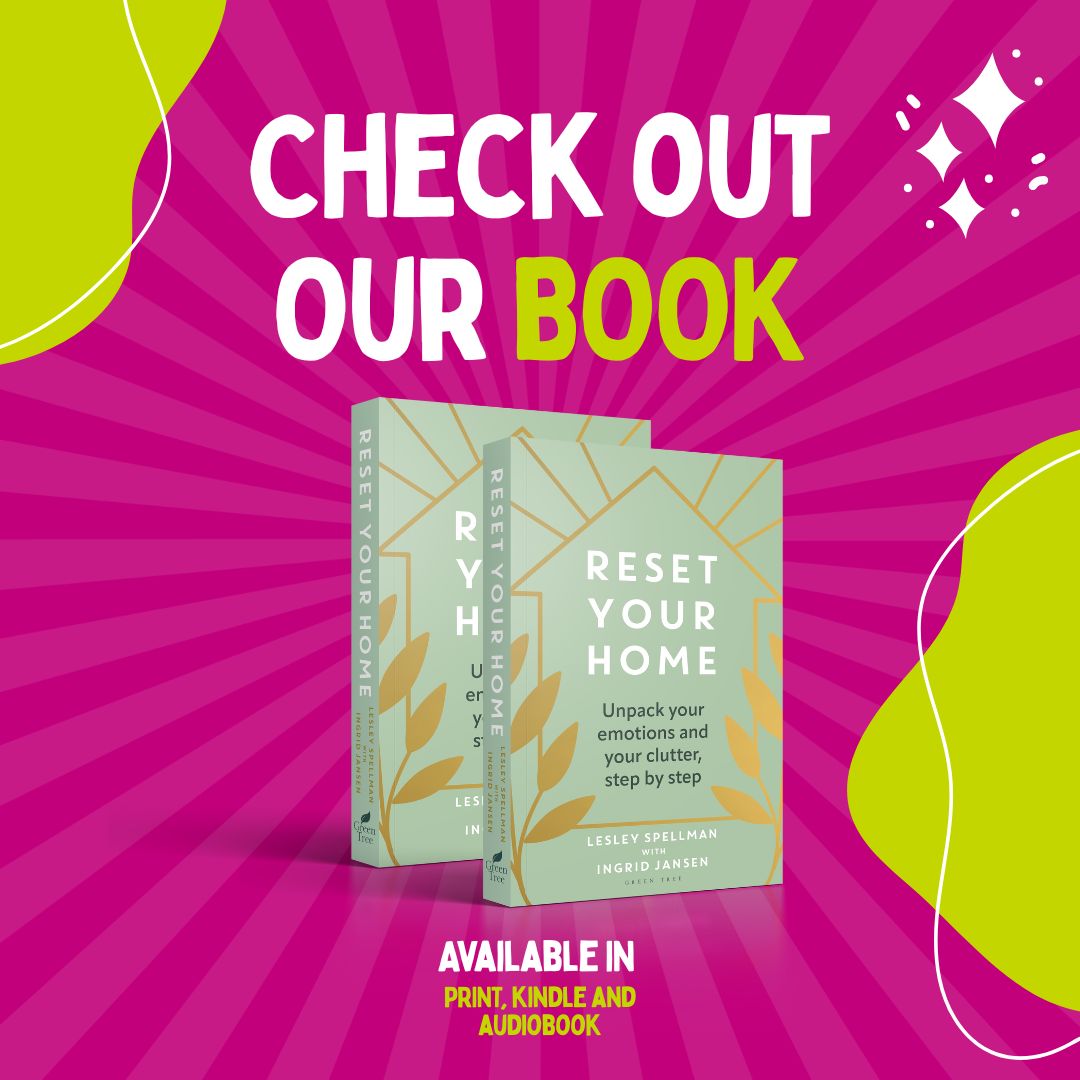
Take a look at our book!
Useful Links and Resources
Subscribe now so you don't miss an episode

Episode 392. I could have used this when I was 30! Who knows if I would have followed through, but the information would have been rattling around in my noggin. It would have been nice to know back in my 30s, that all those things I collected because I had aspirations of reading, doing, and learning whatever the thing was. I did say aspirations because those purchases were rarely used and piled up in our house. Now that I am later in life and our children have grown and flown, I have seen other people my age saying that their adult children don't want their items. Regret, shame, and loss of quality time with our kids is all those things gave me.
Hi Vickie, thank you so much for sharing your thoughts with us and I'm so sorry stuff got in the way for you. Hopefully our podcast has given you some ideas on how to move forwards knowing what you know now, since you can't change the past.